What Kumasi Taught Me About Slowing Down and Finding Real Treasures
You know that rush you get from ticking off tourist spots? I had it too—until Kumasi, Ghana flipped my whole travel mindset. Wandering through vibrant markets not as a shopper, but as a storyteller, I discovered something deeper. This city doesn’t shout; it whispers through kente threads, wooden carvings, and the quiet pride of artisans. Slow travel here isn’t a trend—it’s the only way to truly see. And what you find? Not souvenirs, but soul.
Arrival in Kumasi: First Impressions Beyond the Hustle
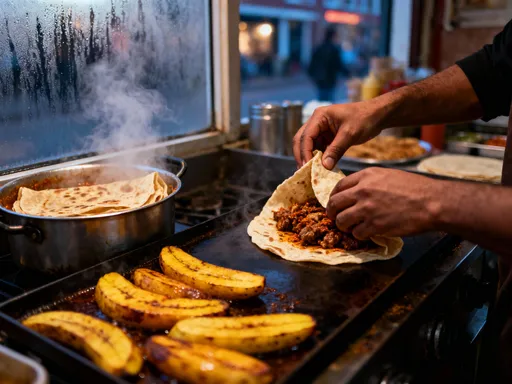
Kumasi greets you with energy that hums beneath the surface, not one that crashes over you like a wave. Arriving by tro-tro—a shared minibus common across Ghana—the first moments are filled with a swirl of motion: vendors balancing baskets on their heads, children chasing each other between parked vehicles, the rhythmic calls of hawkers selling water sachets and boiled groundnuts. The Kotoko Park terminal buzzes with organized chaos, a symphony of honking horns, bartering voices, and the scent of fried plantain hanging in the warm air. It’s easy to feel overwhelmed, to assume this is a city that operates only at full volume.
But beneath the motion lies a different tempo. As you step away from the transport hub and into the quieter streets leading toward the city center, the rhythm begins to shift. The pace doesn’t slow exactly—it deepens. People move with purpose, yes, but also with presence. A woman adjusts her wrap skirt while walking, her posture regal; a man pauses to greet three neighbors in one block, each exchange warm and unhurried. These small moments reveal that Kumasi is not frantic. It is full.
My initial expectation was that Kumasi would be loud, crowded, and difficult to navigate—typical descriptors often used for West African urban centers. Yet what I found was not disorder, but a different kind of order. The market areas weren’t chaotic; they were layered. Each lane had its function, each vendor their role, and the flow of people followed an unspoken but clear logic. What seemed like noise at first revealed itself as conversation. What felt like chaos was actually community in motion. This realization marked the beginning of my shift—from seeing Kumasi as a place to conquer, to one worth sitting with.
Kejetia Market: More Than Just a Shopping Destination
Kejetia Market, often cited as the largest open-air market in West Africa, stretches across several square kilometers and employs tens of thousands of people. To call it a marketplace feels almost inadequate—it is a city within a city, a living organism that breathes with the daily pulse of trade, tradition, and human connection. I entered not with a shopping list, but with curiosity, allowing myself to drift through its labyrinthine pathways without a fixed destination.
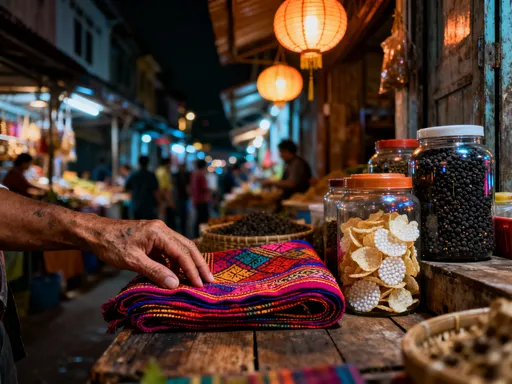
The market is divided into distinct zones, each dedicated to a category of goods. The textile section is a feast for the eyes: bolts of kente cloth in bold geometric patterns, colorful Ankara prints, and hand-dyed fabrics hanging like banners in the sunlight. Nearby, the spice alleys release fragrant clouds of ginger, cloves, and dried chili. The air is thick with scent and sound—the clatter of containers, the hum of bargaining, the occasional burst of laughter from a group of women sharing stories while sorting yams.
What struck me most was not the volume of goods, but the rhythm of exchange. Transactions here are rarely quick. A sale might begin with a question about your journey, continue with a comment on the weather, and only then move to price. Time is not spent efficiently; it is spent meaningfully. One elderly vendor, her head wrapped in a soft blue scarf, invited me to sit on a low stool while she showed me how to distinguish high-quality kente by touch and weave. She didn’t pressure me to buy. She wanted me to understand.
This is where Kejetia transforms from a commercial space into a cultural one. Every item has a story, and every vendor carries knowledge passed down through years, if not generations. To move through Kejetia with haste is to miss the heartbeat of the place. But to walk slowly, to pause, to ask questions—this is how the market reveals itself not as a place of consumption, but of connection.
The Art of Seeing: Why Slow Travel Transforms Shopping into Connection
In many tourist destinations, shopping is transactional. You select, you pay, you leave. In Kumasi, I learned that when you slow down, shopping becomes something else entirely—a form of dialogue. I stopped thinking of myself as a buyer and began to see myself as a guest, welcomed into spaces where livelihoods are built one interaction at a time.
One morning, I spent nearly an hour with Ama, a fabric seller in her fifties who had been at Kejetia for over thirty years. We shared a small cup of ginger tea she brewed over a portable stove. My Twi—the local language—is rudimentary at best, and my attempts to greet her family in their hometown dialect made us both laugh. But language wasn’t the point. The point was presence. She showed me how certain patterns are reserved for funerals, others for weddings, and how some colors carry proverbs woven into their design. I left with a piece of cloth, yes, but more importantly, I left with a story I could tell.
This shift—from consumer to participant—was subtle but profound. When you take the time to learn a vendor’s name, to ask about their day, to accept an offer of water or a seat, you are no longer an outsider. You become part of the moment. And in that moment, the object you eventually purchase carries weight beyond its material form. It becomes a token of shared humanity.
Slow travel, in this context, is not about idleness. It is about intention. It is choosing to see the person behind the product, to honor the skill behind the stitch, to respect the time it takes to do something well. In Kumasi, I learned that the most valuable souvenirs aren’t the ones you display on a shelf—they’re the memories of connection, the quiet moments of understanding that linger long after the journey ends.
Craft Villages on the Outskirts: Bonwire, Ntonso, and the Spirit of Making
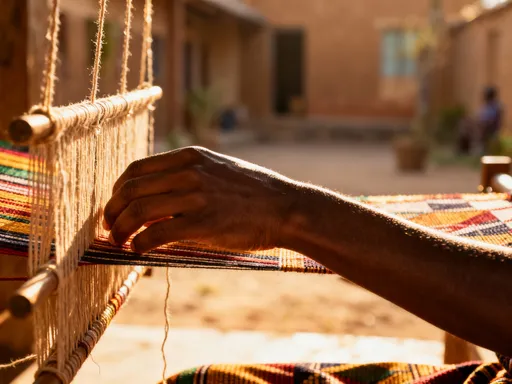
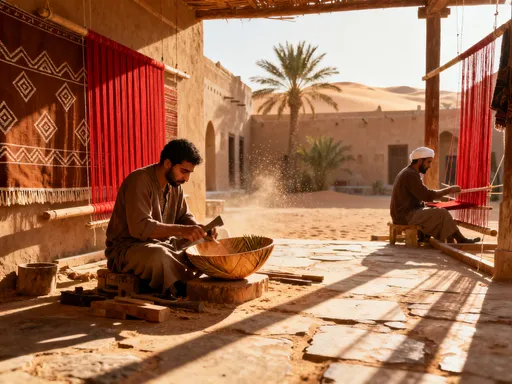
A short drive from Kumasi’s center leads to villages where tradition is not preserved behind glass, but lived daily. Bonwire, renowned for its kente weaving, is one such place. Here, narrow footpaths wind between family compounds where looms sit in shaded courtyards. The sound of weaving—steady, rhythmic, almost meditative—fills the air. Men and women, some elderly, some young, work at wooden looms passed down through generations, their fingers moving with precision and pride.
I was welcomed into a family home where three generations were learning the craft. The grandfather, his hands weathered but steady, demonstrated how to align the threads before the younger members took turns at the loom. There was no rush, no demand for productivity. The focus was on mastery, on continuity. A young boy, no older than ten, wove slowly, his movements careful. “He will be better than me,” the elder said with a smile. “That is how it should be.”
Further on, in Ntonso, the art of adinkra stamping comes alive. Here, artisans use hand-carved calabash stamps to press symbolic patterns onto cloth. Each symbol carries meaning—unity, wisdom, resilience—and the process is deeply intentional. The ink, made from boiled bark, is applied with care. The cloth is laid out to dry in the sun, patterns facing skyward like silent prayers.
What moved me most was the absence of performance. These craftspeople weren’t putting on a show for tourists. They were doing their work, as they do every day. When they noticed my interest, they invited me to try, guiding my hand with patience. I bought a small adinkra cloth directly from the maker, paying a fair price without negotiation—not out of obligation, but out of respect. In that exchange, there was no imbalance, no guilt. There was dignity on both sides.
Hidden Courtyards and Local Studios: Off-the-Beaten-Path Creative Hubs
While Kejetia and the craft villages draw many visitors, some of the most meaningful encounters happened in quieter, less advertised spaces. With no GPS signal and no tour guide, I wandered through residential neighborhoods, following the sound of chisels or the sight of colorful fabrics drying in the breeze. These unplanned detours led me to family-run woodcarving workshops tucked behind compound walls, where artisans shaped ebony and mahogany into stools, masks, and sculptures.
One afternoon, I stumbled upon a small batik studio run by a mother and daughter team. Their workspace was simple—a long table, jars of dye, and dozens of fabric samples hanging from a line. They welcomed me without hesitation, offering a chair and explaining their process. Unlike mass-produced batik sold in tourist shops, their work was done entirely by hand, each piece unique. The daughter, in her early twenties, spoke of wanting to keep the tradition alive while also innovating—she had begun incorporating modern designs inspired by nature and poetry.
These hidden spaces felt different. There was no pressure to buy, no staged demonstrations. The art was not separated from life; it was part of it. I realized that some of the most authentic experiences cannot be found on itineraries. They are discovered through curiosity, through the willingness to get slightly lost, to knock gently on a half-open gate and ask, “May I come in?”
In these moments, I felt a deep sense of gratitude. Not because I acquired something beautiful—though I did—but because I was allowed to witness something real. These creators weren’t selling a performance of culture. They were sharing their daily lives, their values, their dreams. And in doing so, they offered me a gift far greater than any object: the privilege of seeing.
What to Buy—and What to Leave Behind: A Mindful Approach to Market Culture
Travelers often face a dilemma: how to support local artisans without contributing to the commodification of culture. In Kumasi, I learned that mindful purchasing begins with questions—not just about price, but about origin, process, and purpose. Is this made by the person selling it? Was it produced in a way that honors tradition? Does the price reflect the labor involved?
Authenticity can often be sensed, not just seen. A handwoven kente cloth has irregularities—subtle variations in thread tension, slight asymmetries in pattern. These are not flaws; they are proof of human hands at work. In contrast, machine-made imitations are too perfect, too uniform. They lack soul.
I also learned the importance of engagement. A simple gesture—asking the maker to explain a symbol, complimenting their technique, sharing a moment of silence while admiring a piece—can transform a purchase into a mutual exchange. It signals respect. It says, “I see you, not just your product.”
And sometimes, the most responsible choice is to buy nothing at all. Not every interaction needs to end in a transaction. Sitting with a woodcarver for thirty minutes, listening to his stories, thanking him for his time—this, too, is a form of support. It affirms his worth beyond what he can sell. In Kumasi, I learned that carrying culture home isn’t about how much you buy, but about how deeply you pay attention.
Why Kumasi Changes How You Travel—Long After You Leave
Months after returning home, I still find myself thinking about Kumasi—not just the sights, but the pace. The city taught me that travel is not about accumulation. It is not about how many places you see or how many photos you take. It is about how fully you experience a moment, how deeply you connect with a person, how quietly you allow yourself to be changed.
The lessons from Kumasi have reshaped the way I move through the world. I am slower now. I pause before speaking, before buying, before judging. I look for the hands behind the craft, the stories behind the smiles. I ask questions not to fill silence, but to deepen understanding. I carry less in my suitcase, but more in my heart.
True treasures, I’ve learned, are not things. They are shifts in perspective—moments when the world opens up and reveals itself not as a checklist, but as a living, breathing story. Kumasi did not give me souvenirs. It gave me a new way of seeing. And that is a gift that keeps unfolding, one mindful step at a time.